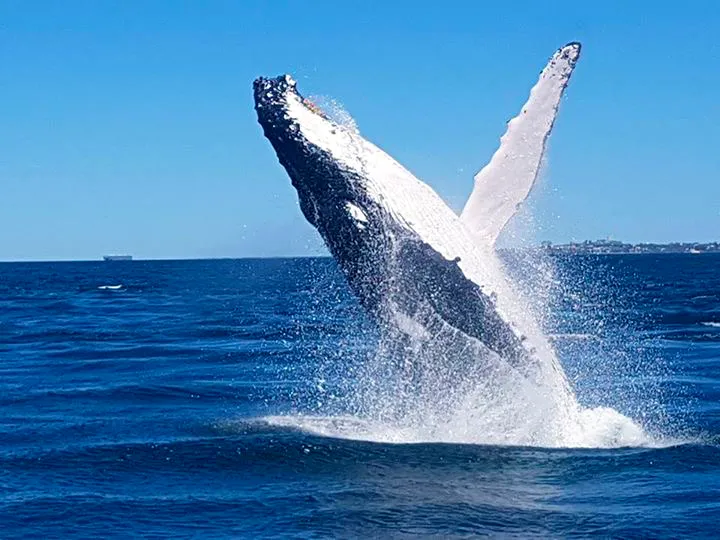
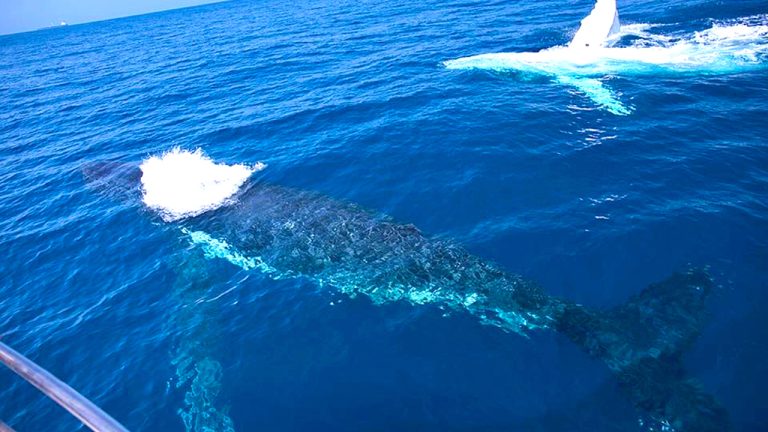
As whale watching season reaches its peak on the Sunshine Coast from late August onwards, the ocean becomes alive with increased humpback whale activity, social interaction and spectacular displays.
This is one of the best times of year for Sunshine Coast whale watching, with whales often travelling closer to shore and spending more time interacting on the surface. Guests aboard Crusader 1 regularly witness breaching whales, tail slapping, competition pods and playful behaviour during this exciting stage of the humpback whale migration.
While every whale encounter is different, late-season whale watching often provides incredible insight into the fascinating mating habits and breeding behaviour of humpback whales.
Why Late August and September Are Peak Whale Watching Months
As humpback whales migrate south along the Queensland coastline, social behaviour becomes much more noticeable.
During this time, whales are often:
- Travelling in groups
- Competing for mates
- Escorting females and calves
- Displaying energetic surface behaviour
- Spending longer periods near vessels
This creates some of the most exciting whale watching conditions of the entire migration season.
Although not every whale chooses to interact closely, experienced crews aboard Crusader 1 work to locate active and curious whales while always maintaining respectful whale watching practices.
When Do Humpback Whales Reach Maturity?
Humpback whales generally reach sexual maturity between 7 and 8 years of age, although many do not become fully reproductively active until several years later.
Female humpback whales typically give birth every two to three years, although some females have been known to calve in consecutive years under favourable conditions.
Humpback Whales Stop Eating During Breeding Season
One of the most extraordinary facts about humpback whale migration is that humpbacks largely stop feeding during the breeding season.
Before migrating north from Antarctica, whales build enormous energy reserves by feeding heavily on krill in cold southern waters.
They then survive much of the migration and breeding season on stored body fat alone while travelling thousands of kilometres along Australia’s east coast.
Humpback Whales Are Not Monogamous
Unlike some marine species, humpback whales are not monogamous.
Both males and females may have multiple partners throughout a single breeding season.
Interestingly, humpback whales have never actually been directly observed mating in the wild. However, researchers and whale watchers have documented a wide range of affectionate and courtship behaviours between whales.
Courtship Behaviour and Bubble Displays
One unusual humpback whale courtship behaviour involves males blowing streams of bubbles beneath females during close interactions.
Marine scientists believe these behaviours may form part of the mating ritual and social communication between whales during breeding season.
These interactions can sometimes be observed during whale watching tours as whales socialise near the surface.
Why Male Humpback Whales Have Battle Scars
Male humpback whales often carry visible scars and markings across their bodies.
These scars are thought to result from fierce competition between males competing for access to females during breeding season.
Competition pods — groups of male whales pursuing a female — are commonly seen during the southern migration and can involve dramatic displays of strength, speed and aggression.
These pods often create some of the most thrilling whale watching encounters on the Sunshine Coast.
Mothers, Calves and Male Escorts
Female humpback whales typically become pregnant in warmer tropical waters before returning south the following season to give birth.
The eastern Australian coastline provides ideal conditions for newborn calves because the warmer water temperatures offer a much safer environment than the freezing Antarctic waters.
After birth, mothers travel south with their calves during migration, and approximately 80% of mother-and-calf pods are accompanied by a male escort whale.
Researchers are still uncertain how long these escort relationships last or what role the males play during this stage.
What is known, however, is that male humpback whales generally do not assist in raising calves.
How Female Humpback Whales Choose Mates
Scientists continue to study how female humpback whales select mating partners.
Interestingly, females rarely interact closely with other females in breeding areas, and researchers still do not fully understand what characteristics females prefer in males.
Possible factors may include:
- Physical strength
- Endurance
- Vocalisations and whale songs
- Competitive behaviour
- Social dominance
Much of humpback whale mating behaviour remains a mystery, making ongoing marine research incredibly important.
Experience Peak Whale Watching on the Sunshine Coast
Late August through October is one of the most exciting periods of the humpback whale migration season on the Sunshine Coast.
From competition pods and breaching whales to mothers travelling with calves, every whale watching tour aboard Crusader 1 offers a unique opportunity to witness these extraordinary marine mammals in their natural environment.
At Sunshine Coast Afloat, our small-group whale watching tours provide guests with a relaxed and immersive experience while learning more about the incredible behaviour and biology of humpback whales.
To learn more about Sunshine Coast whale watching tours, private charters and online bookings, visit Sunshine Coast Afloat.